
Summer tradition: Crabbing offers low-tech family fun
Business initiatives are often measured by their projected “return on investment”, the so-called ROI. Invest $5 and receive $10 in return, you have a positive ROI. The same goes for crabbing.
Toss a $2 chicken leg into the river, and pull in a $6 per pound blue crab and you’ve got a pretty good ROI. You’ve also got a darn good meal! That’s sure to win the approval of your household board of directors, and besides, it’s a whole lot of fun.
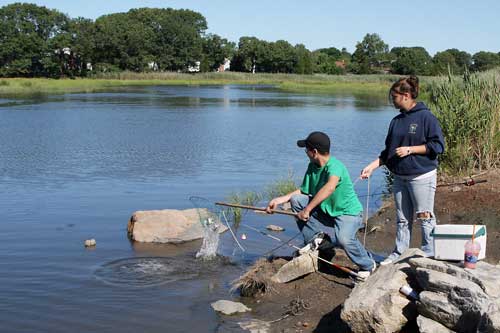
"All kids love crabbing” says Lloyd Hummel, who drove an hour from his Oxford home with his two children, Samantha and Lloyd Jr., in hopes of catching a bushel of delicious blue crabs for their evening dinner. The Hummels made the trip to the Hammonasset River on the Madison/Clinton border as part of a summer tradition the family has enjoyed for the past five years. It’s an opportunity for them to share some quality time together before the hustle of school and extra-curricular activities quickens the pace of their lives come September.
In addition to the assortment of nets and hand lines necessary to catch crabs, the Hummels carry a few fishing poles to try and get a jump on the snapper bluefish that are just starting to invade the tributaries and estuaries by the thousands. Hummel says “The crabbing is usually pretty good here. Even if there aren’t a lot of keepers, it’s still pretty fun.” The snappers taste great dropped in a frying pan or on the grill.
By mid-August, the blue crab population along the shoreline is quickly approaching their 5 inch minimum legal size. Crab aficionados begin to lay claim to their favorite spots along river banks and tease the crustaceans with a variety of baits. Hummel chooses the ever popular raw chicken leg tied on to kite string. With a gentle circular motion, the chicken is tossed into the water about 15 feet from the bank, and left to sit undisturbed for 10 minutes.
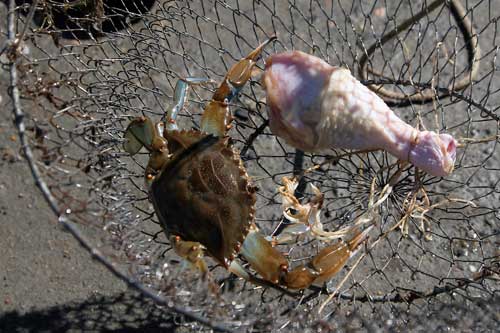
Slowly, the string is pulled in to check for hitchhikers. If a crab has latched onto the bait, the line will feel heavier, and you may even feel the crab scuttling across the river bed as it wrestles to secure its meal. Patience is required. Pull the bait too quickly and the crab will let go.
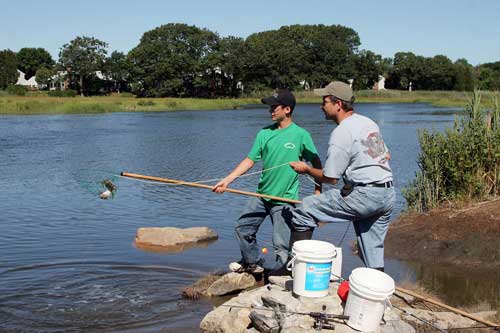
Once you can see the crab’s white underbody through the murky tidal water, grab a long handled crabbing net, and make a decisive but accurate swipe at the sea crawling critter when it is within range. The crab is lightning quick and can disappear back into the water’s darkness before your net even gets wet, so technique becomes critical. Target the rear of the crab and not its claws, as it will attempt to escape by swimming backwards. Don’t get frustrated if you miss a couple crabs.
Some crabbers like to use a quick, thrust and snatch netting technique, while others prefer to guide the crab into the net. Try both methods and see which works best for you. “I’ll pull it in slow and then he’ll (Lloyd Jr.) scoop it up if there is one there.” says Hummel.
The last few hours of the incoming tide is when Hummel prefers to set his baits. Crabs are nocturnal and feed more heavily after dark, but they can be caught any time of day and at any tide. Most of his crabs just exceed the legal size requirement, but Hummel has caught several 7 inch beauties over the years.
Chicken gizzards are a good bait alternative to drumsticks. Purchase a special crabbing rig, from fishing tackle stores, that holds the bait with a strong clip. A lead weight keeps the bait from drifting in the current. Pieces of frozen bunker are another popular bait option.
Blue crab season runs from May 1 st to November 30 th, but the peak action occurs in August and September. Hard shell crabs must measure at least 5 inches from spike tip to spike tip. Egg bearing female crabs, regardless of size, must be released immediately. No license is required and you can keep all the crab that you catch. Traps must be attended at all times.
Crabbing is a fantastic family activity, but be warned that this crustacean is the angriest little monster you will ever drag from the water. It waves its blue colored claws in battle and backs down to nothing or no one. The pinch of even a small crab can bring an adult to their knees in pain. If you have never held a live crab, ask someone to demonstrate how to grab the crab properly so you can avoid its claws.
Crabby Facts
A crab grows larger through the molting process. Its rigid shell must be shed to make room for its internal tissues which grow continuously. When the crab is ready, it will absorb water and swell until it splits its shell across the back. The arduous task of wiggling out backwards follows. Its new will be soft for 2-3 days and about one third larger than the old. “Soft shell” crabs are vulnerable to predators and highly prized among crabbers. A full moon is believed to yield larger catches of soft crabs.
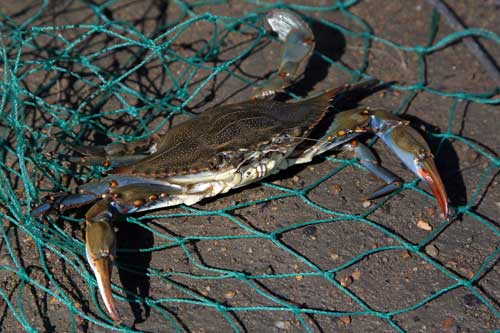
An expert crab picker can extract just over two ounces of meat from a pound of live crabs.
The best method to keep your crab catch fresh is to cover the bottom of a cooler with ice and then put the live crabs on a shelf that keeps them out of the melting water. Do not keep crabs in a bucket of water because they will quickly deplete the dissolved oxygen and then suffocate. Crabs can also be stored in a basket covered by a damp cloth and kept out of direct sunlight.